Maria Nikolaievna Zhivago
Doctor ZhivagoMaria Nikolaievna Zhivago, the sickly mother of Yurii Andreievich Zhivago, is introduced through her funeral: her death leaves her ten-year-old son weeping at her grave and sets the story of his childhood in motion. Though she is present in the novel chiefly through illness, loss, and memory, her absence shapes both the boy’s first experience of bereavement and his understanding of a family life already marked by separation and decline.
Identity and Family
Maria is the wife of Andrei Zhivago and the mother of Yurii. Nikolai Nikolaievich Vedeniapin, her brother, is Yurii’s maternal uncle; at the funeral he comes to the grave and leads the bereaved child away. The surviving account gives Maria no extended biography of her own, but places her within a household whose prosperity has collapsed and whose members have already been separated by illness and abandonment.
Illness and Separation
Maria had long been sickly. After she was found to have consumption, she went to southern France and northern Italy for treatment, and Yurii accompanied her on two occasions. At other times the boy was left with different strangers. These repeated departures made change ordinary to him, while the circumstances of his family remained surrounded by mysteries. He did not know that his father had abandoned the family; he accepted the explanations that Andrei was away on business in Petersburg or at a fair.
The medical journeys therefore belong to more than Maria’s history of illness: they help define the unsettled conditions of Yurii’s early life. Her need to seek treatment repeatedly took her away from home, while his father’s actual absence was concealed from him. The child’s habitual acceptance of change grew within this atmosphere, long before he could understand how much of the family’s former life had disappeared.
Death and Funeral
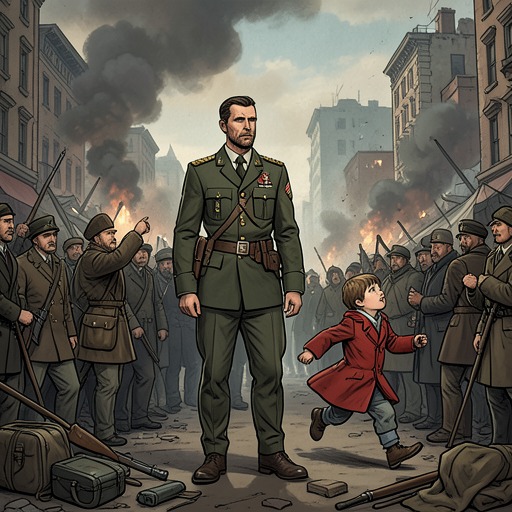
At Maria’s burial, the priest scatters earth over her body and the mourners sing before the coffin is closed, nailed shut, and lowered into the grave. Four spades hurry the filling of the earth until a small mound forms. Yurii climbs onto it. He looks over the bare autumn landscape and monastery domes, then covers his face and breaks into sobs as cold gusts of rain strike him. The scene makes the boy’s grief bodily and immediate: the funeral’s formal rites proceed around a child whose loss exceeds what he can say.
Nikolai, a former priest who had asked to be unfrocked, reaches the grave and leads his nephew out of the cemetery. The next day they are to travel south to a Volga town where Nikolai works for a progressive newspaper publisher. Their packed belongings and nearby station place Yurii’s bereavement at the threshold of another departure; Maria’s death is followed by a change in the boy’s home and care.
Memory and Significance
Yurii’s recollection of his mother’s illness sits beside memories of the family name’s former abundance: a factory, a bank, buildings, a tie pin, even a cake had once borne the name Zhivago. That world vanishes, and the family becomes poor. Maria’s illness and death thus belong to a childhood shaped by both intimate loss and the collapse of inherited security, though the account does not present her death as the cause of the family’s impoverishment.
Maria’s narrative importance lies in the contrast between the funeral’s public ritual and the private bewilderment of her son. The mourners can name the burial and perform its ceremonies; the child’s sobbing registers what those gestures cannot contain. Her death begins the novel’s movement through Yurii’s life with an image of separation that is at once familial, physical, and irretrievable.